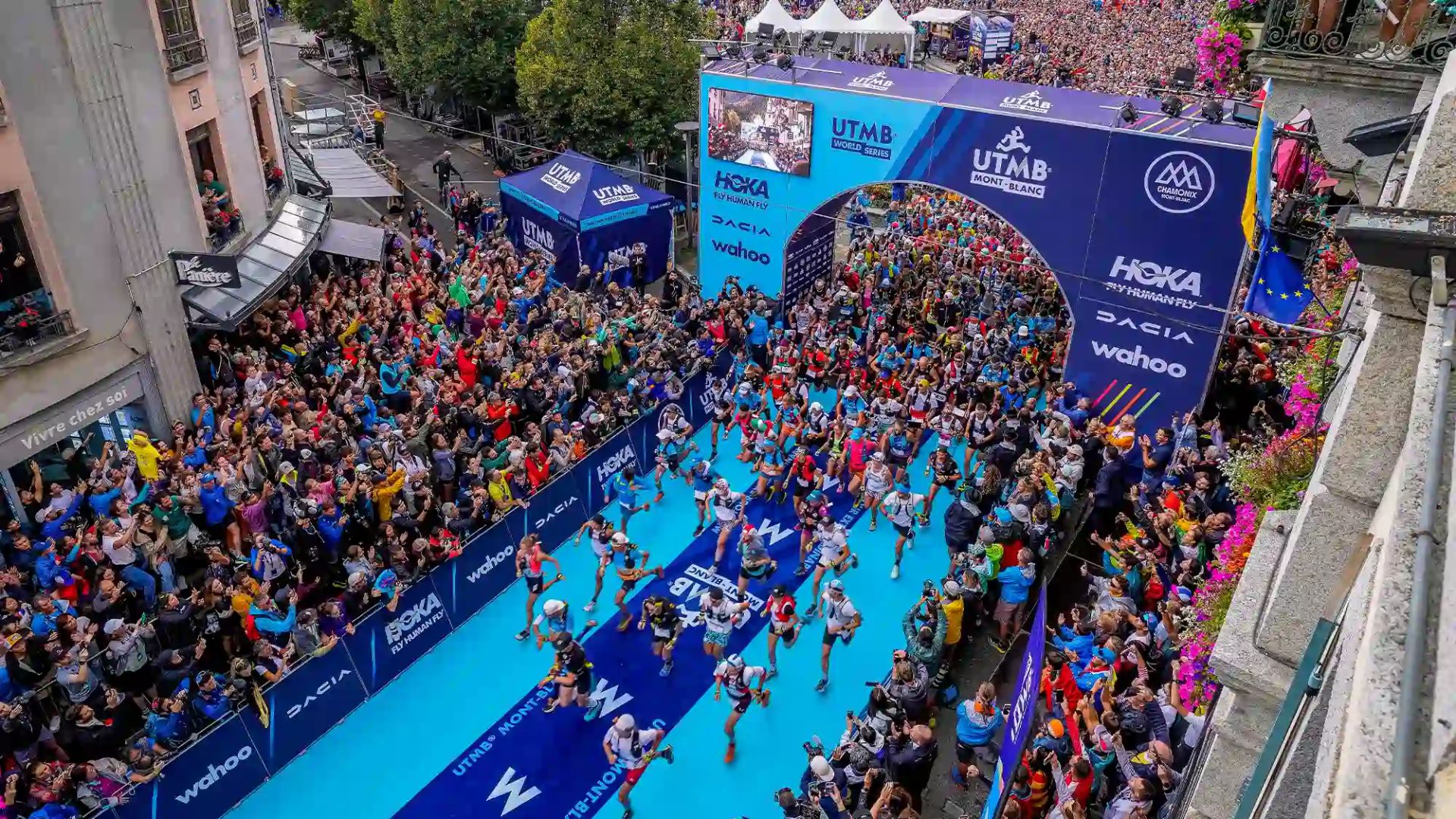
Every August, for one week, Chamonix stops being a mountain town and becomes a stage. Cowbells replace church bells. Headlamps trace the ridgelines after dark. And somewhere between 100,000 and 150,000 people (runners, crews, fans, sponsors, and the simply curious) pour into a valley built for a fraction of that number, to watch a few thousand athletes run themselves into the ground for the love of the mountains.
It is, without question, one of the great spectacles in sport. It is also, increasingly, a question the valley is being forced to ask itself out loud: how much can Chamonix actually hold?
If you’re planning a stay with us during race week, or wondering whether to avoid it altogether, here’s the honest picture.
From a few hundred friends to a global finals week

The Ultra-Trail du Mont-Blanc was born in 2003 as a homemade idea among a small circle of mountain runners: a single loop around Mont Blanc, a few hundred entrants, a finish line that felt like a village fête. There was no live broadcast, no brand village, no queue for the shuttle.
Two decades on, UTMB is the finals of a global World Series with satellite races on nearly every continent. The Chamonix week now fields eight separate races (from the 40km MCC to the brutal 300km, 25,000m-of-climbing PTL) with roughly 10,000 runners on start lines across France, Italy and Switzerland, supported by around 2,000 volunteers. The flagship 106-mile race alone regularly turns away far more qualified applicants than it can accept.
The growth has been genuinely dramatic. A decade ago the week comprised four races and around 5,000 runners. It has since doubled on both counts, and the runners are now the smallest part of the story. The real weight of the week is the crowd that comes to watch them: current estimates put the total influx at well over 100,000 people, arriving into a commune whose permanent population is roughly 8,700.
Do the math on that ratio for a moment. It’s the kind of number that would make any destination pause.
The valley is starting to push back
This isn’t just an outsider’s observation, it’s now the centre of local politics. Chamonix’s newly elected mayor, François-Xavier Laffin, has been unusually candid about it, telling the French sports paper L’Équipe that a “large majority” of residents have grown to resent race week rather than love it, citing gridlock, all-night finish-line noise that can stretch across 20 hours for a single race, and the sense of being locked out of their own town for several days each August.
To be clear, Laffin isn’t calling for the race to end, he’s called it “remarkable”, but he is pushing for a smaller footprint before the 2027 registration cycle: a capped exhibitor village, fewer passages through protected nature reserves, limits on spectator numbers, fewer overnight finishes, and even a gentle discouragement of runners bringing their entire entourage along for the ride. Overtourism and housing, not just UTMB, dominated this year’s mayoral election, a sign that the valley’s patience with sheer volume, in winter and summer alike, is wearing thin.
UTMB Group, for its part, isn’t standing entirely still. The organisation has committed to cutting its carbon footprint by 20% by 2030, banned private cars from over 80% of key course access points in favour of shuttles, and launched new tools and rail partnerships to nudge runners and fans out of cars and onto trains. Whether logistics fixes are enough to answer a question that is really about scale (not just emissions) remains the open debate.
Not just a winter conversation
When people talk about protecting the Alps, the instinct is almost always to talk about snowlines and glaciers, and rightly so; Chamonix sits beneath some of the most visibly retreating ice in Europe. But the environmental conversation can’t stop at the ski lifts. A valley that welcomes millions of visitors a year, and then compresses a six-figure crowd into a single August week, is placing a very different kind of pressure on the same fragile ground: trail erosion through nature reserves, wildlife disturbance in the Aiguilles Rouges, waste and water demand at a scale the infrastructure wasn’t built for, and a housing and hospitality market already stretched thin by year-round demand.
Even some of the sport’s own icons have said as much. Kilian Jornet (arguably trail running’s most respected voice) has openly called for the model to be rethought, worried that the scale UTMB has reached sits uneasily with the low-impact, high-respect ethic the sport was built on.

None of this makes UTMB a villain. It makes it a mirror. The race has simply grown up faster, and more visibly, than the valley’s capacity to absorb it comfortably, and that’s a conversation every high-demand alpine destination, including the luxury end of it, has a stake in.
What this means if you’re staying with us at Amazon Creek
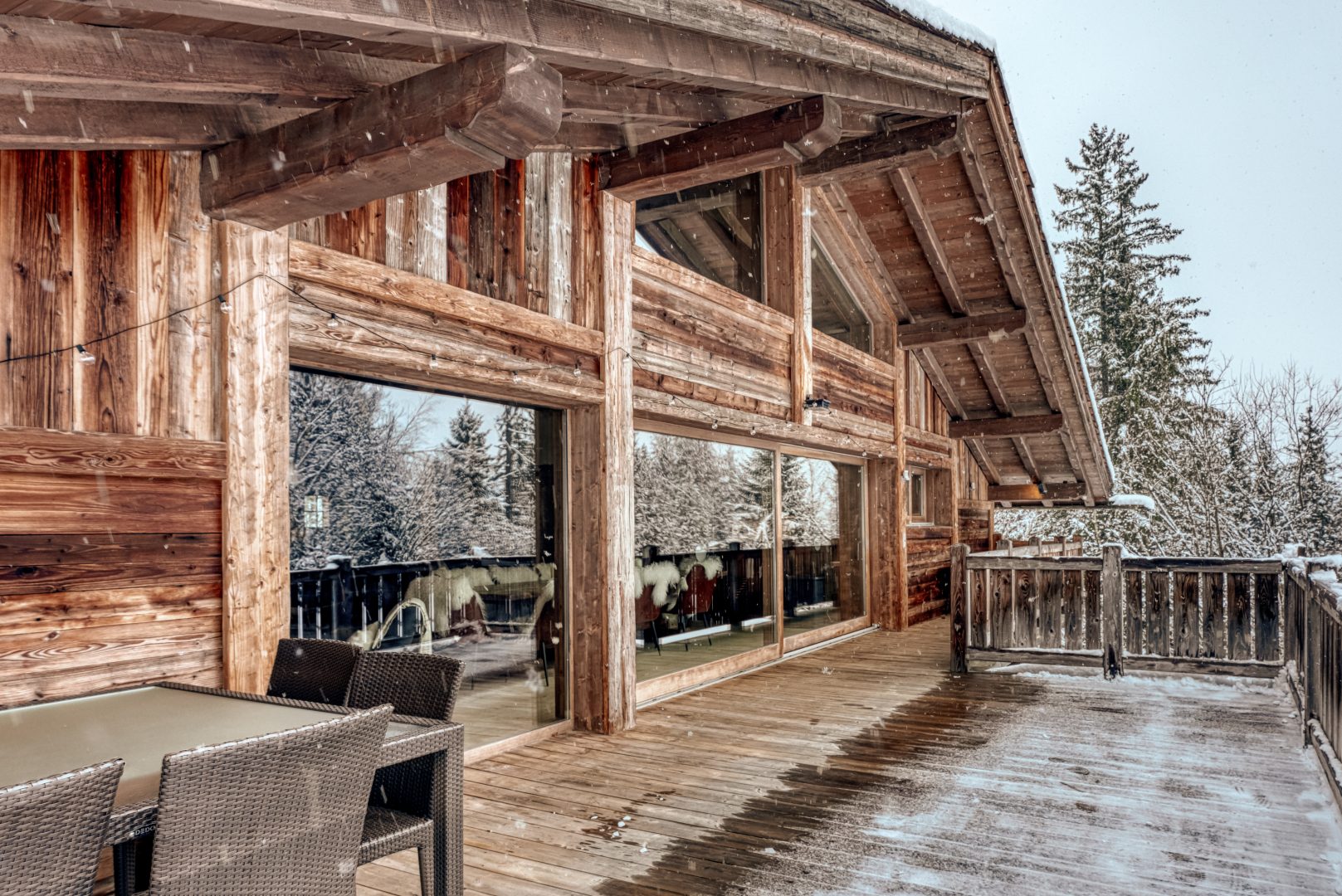
We’re not going to pretend UTMB week isn’t extraordinary to witness, it is. Watching the elite field come through Chamonix under headlamp, the entire town out cheering at 2am, is a genuinely moving thing to see once. If you want that experience, we can plan around it beautifully: a private chalet away from the finish-line noise, a driver so you never fight for a shuttle spot, a chalet just a short walk from part of the route instead of a spot in the crowd in town.


We say this as hosts, too, not just observers. We loved having The North Face crew to stay with us last year, and we can’t wait to welcome them back, along with the professional teams, individual runners and support crews who fill our chalets every August. Between the sponsored athletes, the amateurs chasing a lifetime goal, and the crews keeping them fed, rested and race-ready, UTMB week is, without exaggeration, the single biggest week in Chamonix’s calendar, every single year. That’s exactly why the conversation about its scale matters so much, it’s not a fringe event asking questions of the valley, it’s the main event.


But if your idea of the Mont Blanc valley is quiet trails, empty terraces and a town that feels like your own, race week is probably not your week, and we’ll say so plainly when you ask us. Late June, September and early October give you the same peaks, the same silence on the Grand Balcon Sud, and a Chamonix that still feels like it belongs to the mountains rather than to a finish-line clock.
The Alps we all fell in love with can host a world-class event and protect themselves, but probably not without limits. That’s as true for a race of 10,000 runners as it is for the guests who come to watch them, and it’s something worth having in mind whenever you plan a stay here.
Thinking about the best time to base yourself in Chamonix, race week spectacle or off-season serenity? Get in touch and we’ll help you plan around it.